
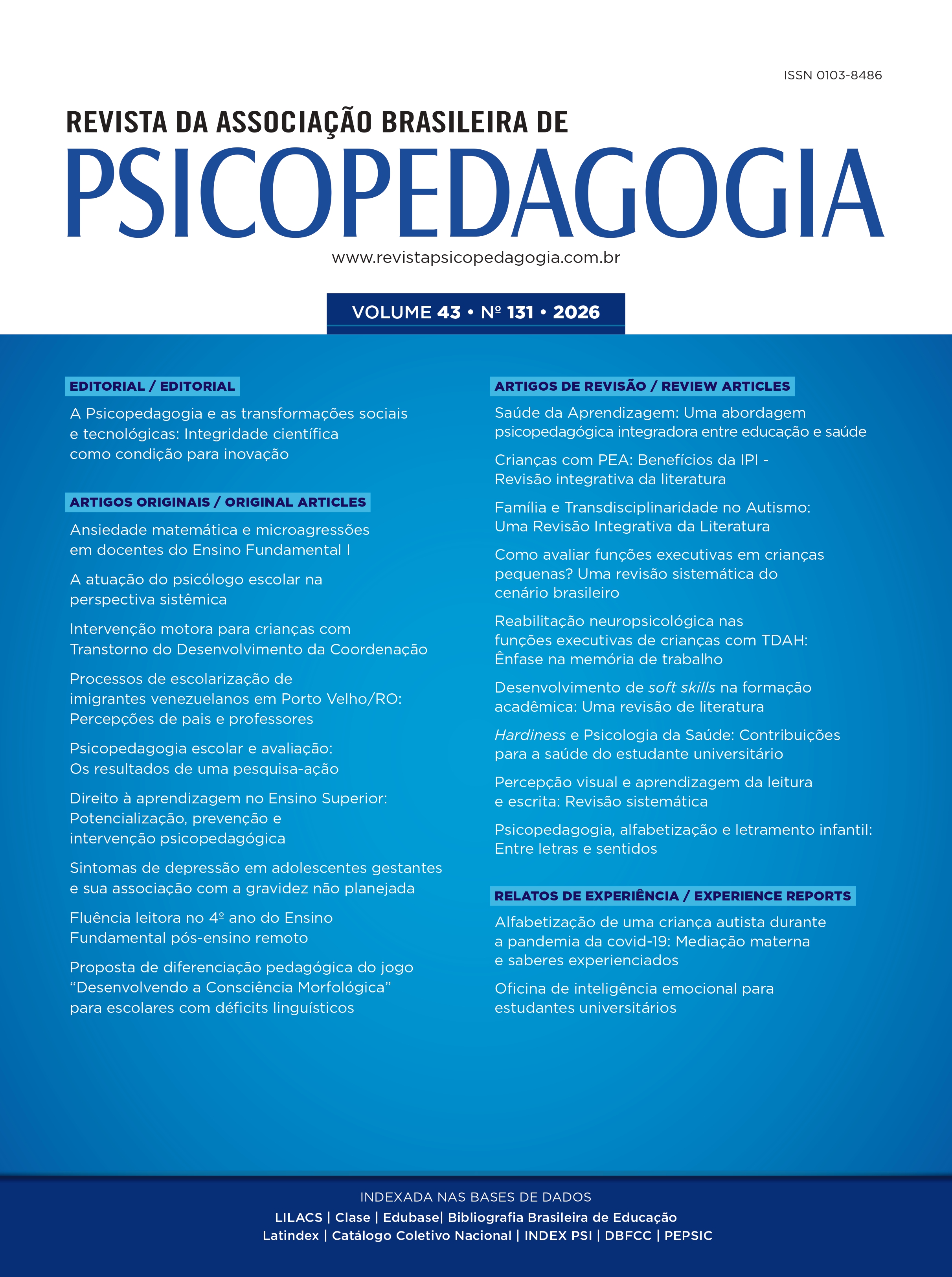
Hardiness e psicologia da saúde
Contribuições para a saúde do estudante universitário
DOI:
https://doi.org/10.51207/2179-4057.20260025Palabras clave:
Hardiness, Psicologia da Saúde, Adaptação Acadêmica, Ajustamento PsicológicoResumen
O público universitário é considerado um grupo com alta vulnerabilidade ao adoecimento por vivenciar diversos estressores no ambiente acadêmico. O perfil de personalidade hardiness tem sido considerado uma importante ferramenta de ajustamento aos desafios acadêmicos. O presente estudo de revisão tem como objetivo geral analisar o hardiness na perspectiva da Psicologia da Saúde com ênfase no público universitário. Para isso, foi realizada uma revisão teórica, de caráter narrativo, crítico e não sistemático, nas bases de dados SciELO, Pepsic, Web of Science e Google Scholar, em setembro de 2024. Constatou-se a relevância do hardiness para a Psicologia da Saúde por atuar como variável mediadora entre o estresse e os desfechos em saúde. Para a saúde do estudante universitário, mostrou-se um importante fator protetivo para o adoecimento relacionado ao estresse acadêmico. Ao final, foram apresentadas limitações da teoria e recomendações para o seu aprimoramento. O estudo de variáveis psicológicas relacionadas ao ajustamento no contexto acadêmico é fundamental para o desenvolvimento de intervenções eficazes e que promovam a redução dos índices de adoecimento e evasão.
Descargas
Citas
Abdollahi, A., Talib, M. A., Yaacob, S. N., & Ismail, Z. (2014). The role of hardiness in decreasing stress and suicidal ideation in a sample of undergraduate students. Journal of Humanistic Psychology, 55(2), 202-222. https://doi.org/10.1177/0022167814543952
Abdollahi, A., Hosseinian, S., Zamanshoar, E., Beh-Pajooh, A., & Carlbring, P. (2018). The moderating effect of hardiness on the relationships between problem-solving skills and perceived stress with suicidal ideation in nursing students. Studia Psychologica, 60(1), 30-41. https://doi.org/10.21909/sp.2018.01.750
Adelusola, C. O., & Onadiji, O. (2020). Influence of hardiness on academic stress among public university undergraduates in southwestern Nigeria. Journal of Education, Psychology and Research (JEPAR), 1(1), 101-114. https://epsonigeria.com/wp-content/uploads/2024/02/FINAL-JEPAR-VOLUME-I-ISSUE-1-with-cover.pdf#page=112
Aditia, L., Wahidah, F. R. N., Na’imah, T., & Nur’aeni, N. (2023). Academic stress in pharmacy practicum students: Is there a role of hardiness?. Journal of Pedagogical Sociology and Psychology, 5(1), 12-19. https://doi.org/10.33902/jpsp.202319347
Almeida, L. S, Soares, A. P. C., & Ferreira, J. A. G. (2000). Transição e adaptação à universidade: Apresentação de um questionário de vivências acadêmicas (QVA). Psicologia, 14(2), 189-208. https://doi.org/10.17575/rpsicol.v14i2.510
Aprodita, N. P. (2021). The relationship between quality of college life and academic hardiness among college students. Jurnal Psikologi Pendidikan & Konseling, 7(1), 1-9. https://ojs.unm.ac.id/JPPK/article/view/15963/0
Araújo, F. R., Oliveira, M. R. S., & Oliveira-Monteiro, N. R. (2021). Envolvimento acadêmico, funcionamento adaptativo, problemas internalizantes e problemas externalizantes em universitários. Psicologia Argumento, 39(104), 222-245. https://doi.org/10.7213/psicolargum.39.104.AO02
Ariño, D. O., & Bardagi, M. P. (2018). Relação entre fatores acadêmicos e a saúde mental dos estudantes universitários. Revista Psicologia em Pesquisa, 12(3), 44-52. https://pepsic.bvsalud.org/scielo.php?script=sci_arttext&pid=S1982-12472018000300005
Bahrami, M., Mohamadirizi, S., & Mohamadirizi, S. (2018). Hardiness and optimism in women with breast cancer. Iranian Journal of Nursing and Midwifery Research, 23(2), 105-110. https://doi.org/10.4103/ijnmr.IJNMR_200_16
Bakhshizadeh, A., Shiroudi, S. G., & Khalatbari, J. (2013). Effect of hardiness training on stress and post partum depression. Procedia - Social and Behavioral Sciences, 84, 1790-1794. https://doi.org/10.1016/j.sbspro.2013.07.035
Bartone, P. T., Hystad, S. W., Eid, J., & Brevik, J. I. (2012). Psychological hardiness and coping style as risk/resilience factors for alcohol abuse. Military Medicine, 177(5), 517-524. https://doi.org/10.7205/milmed-d-11-00200
Bartone, P. T., Valdes, J. J., & Sandvik, A. (2016). Psychological hardiness predicts cardiovascular health. Psychology, Health & Medicine, 21(6), 743-749. https://doi.org/10.1080/13548506.2015.1120323
Bartone, P. T., & Homish, G. G. (2020). Influence of hardiness, avoidance coping, and combat exposure on depression in returning war veterans: A moderated-mediation study. Journal of Affective Disorders, 265, 511-518. https://doi.org/10.1016/j.jad.2020.01.127
Bartone, P. T., McDonald, K., Hansma, B. J., & Solomon, J. (2022). Hardiness moderates the effects of COVID-19 stress on anxiety and depression. Journal of Affective Disorders, 317, 236-244. https://doi.org/10.1016/j.jad.2022.08.045
Beasley, M., Thompson, T., & Davidson J. (2003). Resilience in response to life stress: the effects of coping style and cognitive hardiness. Personality and Individual Differences, 34(1), 77-95. https://doi.org/10.1016/S0191-8869(02)00027-2
Benishek, L. A., & Lopez, F. G. (2001). Development and initial validation of a measure of academic hardiness. Journal of Career Assessment, 9(4), 333-352. https://doi.org/10.1177/106907270100900402
Benishek, L. A., Feldman, J. M., Shipon, R. W., Mecham, S. D., & Lopez, F. G. (2005). Development and evaluation of the revised Academic Hardiness Scale. Journal of Career Assessment, 13(1), 59-76. https://doi.org/10.1177/1069072704270274
Ben-Zur, H., Duvdevany, I., & Lury, L. (2005). Associations of social support and hardiness with mental health among mothers of adult children with intellectual disability. Journal of Intellectual Disability Research: JIDR, 49(Pt 1), 54-62. https://doi.org/10.1111/j.1365-2788.2005.00662.x
Bhattacharjee, A., & Ghosh, T. (2022). COVID-19 Pandemic and stress: Coping with the new normal. Journal of Prevention and Health Promotion, 3(1), 30-52. https://doi.org/10.1177/26320770211050058
Bowsher, J. E., & Keep, D. (1995). Toward an understanding of three control constructs: Personal control, self-efficacy, and hardiness. Issues in Mental Health Nursing, 16(1), 33-50. https://doi.org/10.3109/01612849509042961
Brooks M. V. (2003). Health-related hardiness and chronic illness: A synthesis of current research. Nursing Forum, 38(3), 11-20. https://doi.org/10.1111/j.0029-6473.2003.00011.x
Brooks M. V. (2008). Health-related hardiness in individuals with chronic illnesses. Clinical Nursing Research, 17(2), 98-117. https://doi.org/10.1177/1054773808316736
Carlotto, R. C., Teixeira, M. A. P., & Dias, A. C. G. (2015). Adaptação acadêmica e coping em estudantes universitários. Psico-USF, 20(3), 421-432. https://doi.org/10.1590/1413-82712015200305
Carlucci, S., & Edge, H. M. (2022). An exploratory analysis of hardiness and health behaviours in Canadian Armed Forces recruits. Journal of Military, Veteran and Family Health, 8(2), 94-103. https://doi.org/10.3138/jmvfh-2021-0068
Carver, C. S., & Vargas, S. (2011). Stress, coping, and health. In H. S. Friedman (Ed.), The Oxford Handbook of Health Psychology (pp. 162-188). Oxford University Press. https://doi.org/10.1093/oxfordhb/9780195342819.013.0008
Cohen, S., Murphy, M. L. M., & Prather, A. A. (2019). Ten surprising facts about stressful life events and disease risk. Annual Review of Psychology, 70, 577-597. https://doi.org/10.1146/annurev-psych-010418-102857
Cole, M. S., Field, H. S., & Harris, S. G. (2004). Student learning motivation and psychological hardiness: Interactive effects on students’ reactions to a management class. Academy of Management Learning & Education, 3(1), 64-85. https://doi.org/10.5465/amle.2004.12436819
Creed, P. A., Conlon, E. G., & Dhaliwal, K. (2013). Revisiting the Academic Hardiness Scale: Revision and revalidation. Journal of Career Assessment, 21(4), 537-554. https://doi.org/10.1177/1069072712475285
Delahaij, R., Gaillard, A. W. K., & Dam, K. (2010). Hardiness and the response to stressful situations: Investigating mediating processes. Personality and Individual Differences, 49(5), 386-390. https://doi.org/10.1016/j.paid.2010.04.002
Devani, F., & Saptandari, E. W. (2024). The role of social support and hardiness on academic stress among final-year college students during COVID-19 Pandemic. KnE Social Sciences, 9(6), 452-464. https://doi.org/10.18502/kss.v9i6.15292
Elik, H. K., & Ama, R. G. T. (2024). Final year student academic stress: What is the role of hardiness? Proceeding of International Conference on Healthy Living (INCOHELIV), 1, 40-47. https://doi.org/10.24123/incoheliv.V1i1.6580
Epishin, V. E., Salikhova, A. B., Bogacheva, N. V., Bogdanova, M. D., & Kiseleva, M. G. (2020). Mental health and the COVID-19 pandemic: Hardiness and meaningfulness reduce negative effects on psychological well-being. Psychology in Russia: State of the Art, 13(4), 75-88. https://doi.org/10.11621/pir.2020.0405
Eschleman, K. J., Bowling, N. A., & Alarcon, G. M. (2010). A meta-analytic examination of hardiness. International Journal of Stress Management, 17(4), 277-307. https://doi.org/10.1037/a0020476
Faro, A., & Pereira, M. E. (2013). Estresse: Revisão narrativa da evolução conceitual, perspectivas teóricas e metodológicas. Psicologia, Saúde & Doenças, 14(1), 78-100. https://www.redalyc.org/pdf/362/36226540009.pdf
Funk, S. C. (1992). Hardiness: A review of theory and research. Health Psychology: Official Journal of the Division of Health Psychology, American Psychological Association, 11(5), 335–345. https://doi.org/10.1037//0278-6133.11.5.335
Gebhardt, W. A., van der Doef, M. P., & Paul, L. B. (2001). The revised Health Hardiness Inventory (RRHI-24): Psychometric properties and relationship with self-reported health and health behavior in two Dutch samples. Health Education Research, 16(5), 579-592. https://doi.org/10.1093/her/16.5.579
Heckman, C. J., & Clay, D. L. (2005). Hardiness, history of abuse and women’s health. Journal of Health Psychology, 10(6), 767–777. https://doi.org/10.1177/1359105305057312
Hosseini, S. M., Hesam, S., & Hosseini, S. A. (2022). Relationship of hardiness components to general health, spiritual health, and burnout: The path analysis. Iranian Journal of Psychiatry, 17(2), 196-207. https://doi.org/10.18502/ijps.v17i2.8910
Hull, J. G., Van Treuren, R. R., & Virnelli, S. (1987). Hardiness and health: A critique and alternative approach. Journal of Personality and Social Psychology, 53(3), 518-530. https://doi.org/10.1037/0022-3514.53.3.518
Hutami, N. R., Sugara, G. S., Arumsari, C., & Adiputra, S. (2020). Hardiness training model to reduce burnout in college student. International Journal of Scientific & Technology Research, 9(3), 3469-3474. http://www.ijstr.org/final-print/mar2020/Hardiness-Training-Model-To-Reduce-Burnoutin-College-Student.pdf
Huwae, A., Saija, A. F., & Dese, D. C. (2022). Academic well-being of university students with disability: Role of hardiness and social support. Journal An-Nafs: Kajian Penelitian Psikologi, 7(1), 23-34. https://doi.org/10.33367/psi.v7i1.1948
Hystad, S. W., Eid, J., Laberg, J. C., Johnsen, B. H., & Bartone, P. T. (2009). Academic stress and health: Exploring the moderating role of personality hardiness. Scandinavian Journal of Educational Research, 53(5), 421-429. https://doi.org/10.1080/00313830903180349
Jamal, Y. (2017). Coping strategies as a mediator of hardiness and stress between rescue workers. Studies on Ethno-Medicine, 11(3), 201-208. https://www.researchgate.net/publication/321220655_Coping_Strategies_as_a_Mediator_of_Hardiness_and_Stress_among_Rescue_Workers
Jianping, G., Zhihui, Z., Roslan, S., Zaremohzzabieh, Z., Burhanuddin, N. A. N., & Geok, S. K. (2023). Improving hardiness among university students: A meta-analysis of intervention studies. Frontiers in Psychology, 13, 994453. https://doi.org/10.3389/fpsyg.2022.994453
Kamtsios, S., & Karagiannopoulou, E. (2015). Exploring relationships between academic hardiness, academic stressors and achievement in university undergraduates. Journal of Applied Educational and Policy Research, 1(1), 53-73. https://journals.charlotte.edu/jaepr/article/view/317
Kobasa, S. C. (1979). Stressful life events, personality, and health: An inquiry into hardiness. Journal of Personality and Social Psychology, 37(1), 1-11. https://doi.org/10.1037/0022-3514.37.1.1
Kobasa, S. C., Maddi, S. R., & Kahn, S. (1982). Hardiness and health: A prospective study. Journal of Personality and Social Psychology, 42(1), 168-177. https://doi.org/10.1037/0022-3514.42.1.168
Lazarus, R., & Folkman, S. (1984). Stress appraisal and coping. Springer
Likhacheva, E. V., Ognev, A. S., & Kazakov, K. A. (2013). Hardiness and purposes in life of modern Russian students. Middle East Journal of Scientific Research, 14(6), 795-798. http://www.dslib.net/f/a/p/ad58d8/161369/243466/hardiness_and_purposes_in_life_of_modern_russian_students.pdf
Maddi, S. R. (2004). Hardiness: An operationalization of existential courage. Journal of Humanistic Psychology, 44(3), 279-298. https://doi.org/10.1177/0022167804266101
Maddi, S. R. (2006). Hardiness: The courage to grow from stresses. The Journal of Positive Psychology, 1(3), 160-168. https://doi.org/10.1080/17439760600619609
Maddi, S. R. (2021). Personality hardiness. In K. Sweeny, M. L. Robbins, & L. M. Cohen (Eds.), The Wiley Encyclopedia of Health Psychology (pp. 439-445). Wiley Blackwell. https://doi.org/10.1002/9781119057840.ch94
Maddi, S. R., Khoshaba, D. M., Jensen, K., Carter, E., Lu, J. L., & Harvey, R. H. (2002). Hardiness training for high-risk undergraduates. NACADA Journal, 22(1), 45-55. https://doi.org/10.12930/0271-9517-22.1.45
Maddi, R. S., Harvey, R. H., Khoshaba, D. M., Fazel, M., & Resurreccion, N. (2009). Hardiness training facilitates performance in college. The Journal of Positive Psychology, 4(6), 566-577. https://doi.org/10.1080/17439760903157133
Marks, D. F., Sykes, C. M., & McKinley, J. M. (2003). Health psychology: Overview and professional issues. In A. M. Nezu, C. M. Nezu, & P. A. Geller (Eds.), Handbook of psychology: Health psychology (v 9., pp. 5-23). John Wiley & Sons. https://doi.org/10.1002/0471264385.wei0901
Mirzaian, S. (2021). The role of health hardiness and anxiety on immune system and quality of life patients with HIV. Journal of Modern Psychology, 1(1), 25-36. https://doi.org/10.22034/jmp.2021.127955
Moreno-Jiménez, B., Rodríguez-Muñoz, A., Garrosa Hernández, E., & Blanco, L. M. (2014). Development and validation of the Occupational Hardiness Questionnaire. Psicothema, 26(2), 207-214. https://doi.org/10.7334/psicothema2013.49
Ng, S. M., & Lee, T. M. C. (2020). The mediating role of hardiness in the relationship between perceived loneliness and depressive symptoms among older. Aging & Mental Health, 24(5), 805-810. https://doi.org/10.1080/13607863.2018.1550629
O’Connor, D. B., Thayer, J. F., & Vedhara, K. (2021). Stress and health: A review of psychobiological processes. Annual Review of Psychology, 72, 663-688. https://doi.org/10.1146/annurev-psych-062520-122331
Oral, M., & Karakurt, N. (2022). The impact of psychological hardiness on intolerance of uncertainty in university students during the COVID-19 pandemic. Journal of Community Psychology, 50(8), 3574-3589. https://doi.org/10.1002/jcop.22856
Pollock, S. E. (1986). Human responses to chronic illness: physiologic and psychosocial adaptation. Nursing Research, 35(2), 90-95. https://pubmed.ncbi.nlm.nih.gov/3633512/
Pollock, S. E., & Duffy, M. E. (1990). The Health-Related Hardiness Scale: development and psychometric analysis. Nursing Research, 39(4), 218-222. https://pubmed.ncbi.nlm.nih.gov/2367202/
Ribeiro, J. L. P. (2011). A Psicologia da saúde. In R. F. Alves (org.), Psicologia da Saúde: teoria, intervenção e pesquisa (pp. 23-64). EDUEPB. https://books.scielo.org/id/z7ytj/pdf/alves-9788578791926-02.pdf
Robinson, A. M. (2018). Let’s talk about stress: History of stress research. Review of General Psychology, 22(3), 334-342. https://doi.org/10.1037/gpr0000137
Rother, E. T. (2007). Revisão sistemática x revisão narrativa. Acta Paulista de Enfermagem, 20(2), 5-6. https://doi.org/10.1590/S0103-21002007000200001
Sahão, F. T., & Kienen, N. (2020). Comportamentos adaptativos de estudantes universitários diante das dificuldades de ajustamento à universidade. Quaderns de Psicologia, 22(1), e1612. https://doi.org/10.5565/rev/qpsicologia.1612
Sandvik, A. M., Bartone, P. T., Hystad, S. W., Phillips, T. M., Thayer, J. F., & Johnsen, B. H. (2013). Psychological hardiness predicts neuroimmunological responses to stress. Psychology, Health & Medicine, 18(6), 705-713. https://doi.org/10.1080/13548506.2013.772304
Santos, J. J. D., & Faro, A. (2022). Hardiness, estresse e adaptação acadêmica: uma revisão narrativa da literatura. Revista Psicopedagogia, 39(119), 229-241. https://doi.org/10.51207/2179-4057.20220020
Santos, J. J. D., & Faro, A. (2025). Predictive model of anxious and depressive symptoms based on the relationship between hardiness and academic adaptation. Psicologia: Teoria e Pesquisa, 41, e41303. https://doi.org/10.1590/0102.3772e41303.en
Sarani, A., Azhari, S., Mazloum, S. R., & Sherbaf, H. A. (2015). The relationship between psychological hardiness and coping strategies during pregnancy. Journal of Midwifery and Reproductive Health, 3(3), 408-417. https://doi.org/10.22038/jmrh.2015.4432
Selye, H. (1991). History and present status of the stress concept. In A. Monat & R. Lazarus (Eds.), Stress and Coping: an Anthology (pp. 21-35). Columbia University Press. https://doi.org/10.7312/mona92982-007
Shirazi, M., Chari, M., Kahkha S. J., & Marashi, F. (2018). The role of hope for the future and psychological hardiness in quality of life among dialysis patients. Jentashapir Journal of Cellular and Molecular Biology, 9(3), e67827. https://doi.org/10.5812/jjhr.67827
Silva, R. M., Goulart, C. T., & Guido, L. A. (2018). Evolução histórica do conceito de estresse. Revista Científica Sena Aires, 7(2), 148-156. https://pesquisa.bvsalud.org/portal/resource/pt/biblio-1096966
Silva-Junior, R. F., Alves, E. C. S., Santos, K. de O., Santos, S. P., Barbosa, H. A., Siqueira, L. das G., Torres, J. D. P. R. V., & Silva, C. S. O. (2020). Personalidade hardiness e fatores associados em profissionais da saúde atuantes em serviços que atendem pacientes críticos. Ciência & Saúde Coletiva, 25(1), 199-209. https://doi.org/10.1590/1413-81232020251.29442019
Skinner, E. A., Edge, K., Altman, J., & Sherwood, H. (2003). Searching for the structure of coping: A review and critique of category systems for classifying ways of coping. Psychological Bulletin, 129(2), 216-269. https://doi.org/10.1037/0033-2909.129.2.216
Sousa, K., & Faro, A. (2021). Psicologia da saúde e COVID-19: Cenário para compreensão e atuação na pandemia. In A. Faro, E. Cerqueira-Santos & J. P. Silva (Orgs.), Psicologia e COVID-19: Saúde, desenvolvimento e educação (pp. 27-57). Editora Dialética.
Straub, R. O. (2014). Psicologia da saúde: Uma abordagem biopsicossocial (3a ed.). Artmed.
Tadayon, M., Dabirizadeh, S., Zarea, K., Behroozi, N., & Haghighizadeh, M. H. (2018). Investigating the relationship between psychological hardiness and resilience with depression in women with breast cancer. The Gulf Journal of Oncology, 1(28), 23-30. https://www.researchgate.net/publication/328462669_Investigating_the_relationship_between_psychological_hardiness_and_resilience_with_depression_in_women_with_breast_cancer
Tho, N. D. (2019). Business students’ hardiness and its role in quality of university life, quality of life, and learning performance. Education + Training, 61(3), 374-386. https://doi.org/10.1108/ET-03-2018-0068
Thomassen, Å. G., Hystad, S. W., Johnsen, B. H., Johnsen, G. E., & Bartone, P. T. (2018). The effect of hardiness on PTSD symptoms: A prospective mediational approach. Military Psychology, 30(2), 142-151. https://doi.org/10.1080/08995605.2018.1425065
Totskiy, D., Alekhin, A., Leonenko, N., Pultcina, C., Belyaeva, S., & Guzi, L. (2021). The psychological hardiness of students with a high insomnia index during the Covid-19 pandemic. E3S Web of Conferences, 258, 1-11. https://doi.org/10.1051/e3sconf/202125807092
Vagni, M., Giostra, V., Maiorano, T., Santaniello, G., & Pajardi, D. (2020a). Personal accomplishment and hardiness in reducing emergency stress and burnout among covid-19 emergency workers. Sustentabilidade, 12(21), 9071. https://doi.org/10.3390/su12219071
Vagni, M., Maiorano, T., Giostra, V., & Pajardi, D. (2020b). Hardiness, stress and secondary trauma in Italian healthcare and emergency workers during the COVID-19 Pandemic. Sustainability, 12(14), 5592. https://doi.org/10.3390/su12145592
Vasconcelos, A. G., & Nascimento, E. (2016). Teoria Motivacional do Coping: Um modelo hierárquico e desenvolvimental. Avaliação Psicológica, 15, 77-87. https://pepsic.bvsalud.org/scielo.php?script=sci_arttext&pid=S1677-04712016000300009
Wardani, R. (2020). Academic hardiness, skills, and psychological well-being on new student. Jurnal Psikologi, 19(2), 188-200. https://doi.org/10.14710/jp.19.2.188-200
Wiebe, D. J. (2013). Hardiness and health. In M. D. Gellman & J. R. Turner (Eds.), Encyclopedia of Behavioral Medicine (pp. 893-895). Springer. https://doi.org/10.1007/978-1-4419-1005-9_957
Wiebe, D. J., & Williams, P. G. (1992). Hardiness and health: A social psychophysiological perspective on stress and adaptation. Journal of Social and Clinical Psychology, 11(3), 238-262. https://doi.org/10.1521/jscp.1992.11.3.238
Wu, E. W., Hagan, M. J., Eschleman, K., & Gard, D. E. (2024). Hardiness predicts mental health recovery during the COVID-19 pandemic. Psychological Trauma: Theory, Research, Practice, and Policy, 16(6), 971-979. https://doi.org/10.1037/tra0001660
Zanon, C., Borsa, J. C., Bandeira, D. R., & Hutz, C. S. (2012). Relações entre pensamento ruminativo e facetas do neuroticismo. Estudos de Psicologia (Campinas), 29(2), 173-181. https://doi.org/10.1590/S0103-166X2012000200003
Zhavira, R., & Palupi, L. S. (2022). Academic hardiness and psychological well-being among university students. INSAN Jurnal Psikologi Dan Kesehatan Mental, 7(2), 145-155. https://doi.org/10.20473/jpkm.v7i22022.145-155
Descargas
Publicado
Cómo citar
Número
Sección
Licencia
Derechos de autor 2026 Jéssica July Dantas Santos, André Faro

Esta obra está bajo una licencia internacional Creative Commons Atribución-NoComercial 4.0.


