
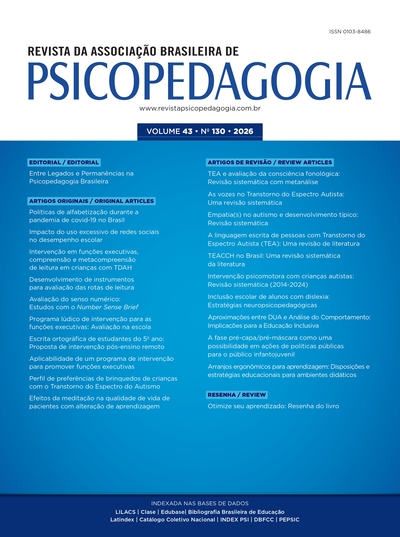
TEA e avaliação da consciência fonológica
Revisão sistemática com metanálise
DOI:
https://doi.org/10.51207/2179-4057.20260019Palabras clave:
Desenvolvimento de Leitura, Avaliação das Condições de Aprendizagem, Transtorno do Espectro Autista, Revisão SistemáticaResumen
O processo de avaliação da aquisição da leitura em crianças com Transtorno do Espectro Autista (TEA) tem sido um desafio diante da carência de instrumentos adaptados que permitam uma avaliação eficaz sobre a Consciência Fonológica (CF). O objetivo primário desse estudo foi identificar quais instrumentos foram usados para avaliar CF no processo de alfabetização da criança com TEA. Foram considerados como critérios de elegibilidade o anagrama PICOT em que a população é composta por crianças autistas menores de 8 anos, a intervenção refere-se a CF, o comparador são crianças em desenvolvimento típico, o desfecho se refere aos instrumentos de medida das variáveis preditoras e do tipo observacional de estudo. A pesquisa abrangeu estudos realizados entre 2014 e 2024 e resultou em 15 artigos, os quais foram pesquisados de maio a junho de 2024 em bases de dados online, dentre as quais: Education Resources Information Center (ERIC), Google Scholar, Scientific Electronic Library Online (SciELO) e Periódicos CAPES. A metanálise foi conduzida com o software Review Manager. Os dados revelaram que os instrumentos mais utilizados foram: PALSPREK e TOPEL. A metanálise demonstra um prejuízo identificado a partir do TOPEL. Os fatores que limitaram a evidência foram o pequeno número de estudos e a diversidade de instrumentos. Identificou-se ainda a carência de estudos que avaliem amostras de maior magnitude e a necessidade de adaptações e traduções desses instrumentos para o público em questão. Este estudo está registrado no PROSPERO nº CRD42024546660.
Descargas
Citas
Adams, M. J. (2012). Consciência fonológica em crianças pequenas. Artmed.
American Educational Research Association, American Psychological Association, & National Council on Measurement in Education. (2014). Standards for educational and psychological testing. American Educational Research Association.
Bailey, B., Arciuli, J., & Stancliffe, R. J. (2017). Efeitos da instrução de alfabetização ABRACADABRA em crianças com transtorno do espectro autista. Journal of Educational Psychology, 109(2), 257.
Bean, A. F., Perez, B. I., Dynia, J. M., Kaderavek, J. N., & Justice, L. M. (2020). Book-reading engagement in children with autism and language impairment: Associations with emergent-literacy skills. Journal of Autism and Developmental Disorders, 50(3), 1018-1030.
Befi-Lopes, D. M, Leão, L. F. A., & Soares, A. J. C. (2022). Relações entre idade cronológica e linguística e consciência fonológica em crianças com transtorno do desenvolvimento de linguagem. Revista CEFAC, 24(3), e6521.
Belteki, Z., Lumbreras, R., Fico, K., Haman, E., & Junge, C. (2022). The vocabulary of infants with an elevated likelihood and diagnosis of autism spectrum disorder: A systematic review and meta-analysis of infant language studies using the CDI and MSEL. International Journal of Environmental Research and Public Health, 19(3), 1469.
Collazos-Campo, C. A., Cadavid-Ruiz, N., Gómez, J. D., Jiménez-Jiménez, S., & Quijano-Martínez, M. C. (2020). Predictors of early reading acquisition in children of low socioeconomic status. Paidéia (Ribeirão Preto), 30, e3037.
Clendon, S., Paynter, J., Walker, S., Bowen, R., & Westerveld, M. F. (2021). Emergent literacy assessment in children with autism spectrum disorder who have limited verbal communication skills: A tutorial. Language, Speech, and Hearing Services in Schools, 52(1), 165-180. https://doi.org/10.1044/2020_LSHSS-20-00030
Cristofoli, B. G., Alves, L. R. N., Büttenbender, C., Scotti, E. B., Almeida, A., N., & Ribas, L. P. (2023). Pragmatic disorders in children with Phonological Disorder: a systematic review. Revista Distúrbios da Comunicação (PUC-SP), 35(3), e56381.
Dehaene, S., Cohen, L., Morais, J., & Kolinsky, R. (2015). Illiterate to literate: behavioural and cerebral changes induced by reading acquisition. Nature Reviews Neuroscience, 16(4), 234-244.
de Araújo Baptistello, G., Haas, C., Rabello, V. B., Favero, B. P., Lech, G. E., Freitas, C. C., Sturmer, C. M., Steinbruch, A. R., Gomes, L. F. P., Rocha, G. S., & Halal, C. S. (2023). Autism spectrum disorders and differential diagnosis of speech delays in childhood: a literature review. Residência Pediátrica, 13(2), 970.
Dynia, J. M., Lawton, K., Logan, J. A., & Justice, L. M. (2014). Comparing emergent-literacy skills and home-literacy environment of children with autism and their peers. Topics in Early Childhood Special Education, 34(3), 142-153.
Dynia, J. M., Brock, M. E., Justice, L. M., & Kaderavek, J. N. (2017). Predictors of decoding for children with autism spectrum disorder in comparison to their peers. Research in Autism Spectrum Disorders, 37, 41-48.
Dynia, J. M., Bean, A., Justice, L. M., & Kaderavek, J. N. (2019). Phonological awareness emergence in preschool children with autism spectrum disorder. Autism & Developmental Language Impairments, 4, 1-15.
Dynia, J. M., Walton, K. M., Brock, M. E., & Tiede, G. (2020). Early childhood special education teachers’ use of evidence-based practices with children with autism spectrum disorder. Research in Autism Spectrum Disorders, 77, 101606.
Fleury, V. P., & Lease, E. M. (2018). Early indication of reading difficulty? A descriptive analysis of emergent literacy skills in children with autism spectrum disorder. Topics in Early Childhood Special Education, 38(2), 82-93.
Fleury, V. P., & Hugh, M. L. (2018). Exploring Engagement in Shared Reading Activities Between Children with Autism Spectrum Disorder and Their Caregivers. Journal of autism and developmental disorders, 48(10), 3596-3607. https://doi.org/10.1007/s10803-018-3632-8
Giazitzidou, S., Mouzaki, A., & Padeliadu, S. (2024). Pathways from morphological awareness to reading fluency: the mediating role of phonological awareness and vocabulary. Reading and Writing, 37(5), 1109-1131.
Grigorenko, E. L., Klin, A., Pauls, D. L., Senft, R., Hooper, C., & Volkmar, F. (2002). A descriptive study of hyperlexia in a clinically referred sample of children with developmental delays. Journal of Autism and Developmental Disorders, 32(1), 3-12.
Heimann, M., Nelson, K. E., Tjus, T., & Gillberg, C. (1995). Increasing reading and communication skills in children with autism through an interactive multimedia computer program. Journal of Autism and Developmental Disorders, 25(5), 459-480.
Higgins, J. P. T., Thomas, J., Chandler, J., Cumpston, M., Li, T., Page, M. J., & Welch, V. A. (Eds.). (2023). Cochrane Handbook for Systematic Reviews of Interventions (versão 6.4). Cochrane. www.training.cochrane.org/handbook
Hudson, R. F., Sanders, E. A., Greenway, R., Xie, S., Smith, M., Gasamis, C., Martini, J., Schwartz, I., & Hackett, J. (2017). Effects of Emergent Literacy Interventions for Preschoolers With Autism Spectrum Disorder. Exceptional Children, 84(1), 55-75.
Invernizzi, M., Meier, J., & Swank, L. (2004). Phonological Awareness Literacy Screening for Preschoolers (PALS-PreK) [Database record]. APA PsycTests.
Katzenberger, I., & Meilijson, S. (2014). Hebrew language assessment measure for preschool children: A comparison between typically developing children and children with specific language impairment. Language Testing, 31(1), 19-38.
Khan, K. S., Logan, J., Justice, L. M., Bowles, R. P., & Piasta, S. B. (2021). The contribution of vocabulary, grammar, and phonological awareness across a continuum of narrative ability levels in young children. Journal of Speech, Language, and Hearing Research, 64(9), 3489-3503.
Kimhi, Y., Achtarzad, M., & Tubul-Lavy, G. (2018). Emergent literacy skills for five kindergartners with autism spectrum disorder: a pilot study. Journal of Research in Special Educational Needs, 18(3), 211-221.
Korkman, M., Kirk, U., & Kemp, S. (2007). NEPSY II: Manual clínico e interpretativo. PsychCorp.
Kucharská, A., Špačková, K., & Šmejkalová, M. (2022). Language awareness as a prerequisite of literacy skills. LingBaW Linguistics Beyond and Within, 8, 114-132.
Lanter, E. (2009). Emergent literacy development in children with autism spectrum disorders. The University of North Carolina at Chapel Hill.
Lonigan, C. J., & Shanahan, T. (2010). Developing early literacy skills: Things we know we know and things we know we don’t know. Educational Researcher, 39(4), 340-346.
Lonigan, C., Wagner, R., Torgesen, J., & Rashotte, C. (2007). Test Review: Test of Preschool Early Literacy (TOPEL). National Early Literacy Panel.
Macdonald, D., Luk, G., & Quintin, E. M. (2021). Early word reading of preschoolers with ASD, both with and without hyperlexia, compared to typically developing preschoolers. Journal of autism and developmental disorders, 51(5), 1598-1612.
McIntyre, N. S., Solari, E. J., Grimm, R. P., E Lerro, L., E Gonzales, J., & Mundy, P. C. (2017). A comprehensive examination of reading heterogeneity in students with high functioning autism: Distinct reading profiles and their relation to autism symptom severity. Journal of Autism and Developmental Disorders, 47(4), 1086-1101.
Moojen, S., Lamprecht, R., Santos, R.M., Freitas, G.M., Brodacz, R., Siqueira, M., Costa, A.C. & Guarda, E. (Eds.). (2003). Consciência Fonológica: instrumento de avaliação sequencial -CONFIAS. Casa do Psicólogo.
Muñoz-Oyarce, M. F., Monzalve-Macaya, M., Almonacid Fierro, A., & Merellano-Navarro, E. (2020). Nivel de conciencia fonológica en estudantes con funcionamiento intelectual limítrofe. Avances en Psicología Latinoamericana, 38(2), 53-66.
Náples, A., & McPartland, J. C. (2021). Hyperlexia. In Encyclopedia of Autism Spectrum Disorders (pp. 2372-2375). Springer International Publishing.
Pagliarin, K. C., Gubiani, M. B., Rosa, R. R., & Keske-Soares, M. (2022). Performance in the accuracy task in children with Childhood Apraxia of Speech after an integrated intervention of literacy and motor skills. Codas, 34(2), e20210126.
Rimmer, C., Philibert-Lignières, G., Iarocci, G., & Quintin, E. M. (2024). The Contribution of Perceptual Reasoning Skills to Phonological Awareness for School Age Autistic Children. Journal of Autism and Developmental Disorders, 54(4), 1361-1375.
Solari, E. J., Henry, A. R., Grimm, R. P., Zajic, M. C., & McGinty, A. (2022). Code-related literacy profiles of kindergarten students with autism. Autism, 26(1), 230-242.
Souza, L. B. R. (2004). Perfil das habilidades de consciência fonológica em crianças alfabetizadas: estudo comparativo. [Dissertação de mestrado, Universidade Federal do Rio Grande do Norte].
Stanovich, K. E. (1986). Matthew effects in reading: Some consequences of individual differences in the acquisition of literacy. Reading Research Quarterly, 21(4), 360–407. https://www.jstor.org/stable/747612
Sucena, A., Silva, A. F., & Marques, C. (2023). Reading skills promotion: Results on the impact of a preschool intervention. In Frontiers in Education (vol. 7, p. 1076630). Frontiers Media SA.
Vargas, N. B. (2020). Difficulties in emergent literacy skills in preschool children with specific language impairment. A systematic review.
Vukovic, M., Jovanovska, M., & Jerkic Rajic, L. (2022). Phonological awareness in children with developmental language disorder. Archives of Public Health, 14(1), 135-144. https://doi.org/10.3889/aph.2022.6046
Waddington, H., van der Meer, L., Carnett, A., & Sigafoos, J. (2017). Teaching a child with ASD to approach communication partners and use a speech-generating device across settings: Clinic, school, and home. Canadian Journal of School Psychology, 32(3/4), 228-243.
Westerveld, M. F., Trembath, D., Shellshear, L., & Paynter, J. (2016). A systematic review of the literature on emergent literacy skills of preschool children with autism spectrum disorder. The Journal of Special Education, 50(1), 37-48.
Westerveld, M. F., Paynter, J., Trembath, D., Webster, A. A., Hodge, A. M., & Roberts, J. (2017). The emergent literacy skills of preschool children with autism spectrum disorder. Journal of Autism and Developmental Disorders, 47(2), 424-438.
Westerveld, M. F., Paynter, J., O’Leary, K., & Trembath, D. (2018). Preschool predictors of reading ability in the first year of schooling in children with ASD. Autism Research, 11(10), 1332-1344.
Zazula, R., Sartor, M. S., Dias, N. G., & Gon, M. C. C. (2014). Uso de medidas diretas e indiretas para avaliação de problemas de comportamento em crianças com dermatite atópica. In V. B. Haydu, S. A. Fornazari, & C. R. Estanislau (Orgs.), Psicologia e Análise fazer Comportamento: Conceituações e aplicações para educação, organizações, saúde e clínica (pp. 267-287). UEL.
Zhang, S., Prykanowski, D. A., & Koppenhaver, D. A. (2023). Using Construction-Integration Theory to Interpret Reading Comprehension Instruction for Students with Autism Spectrum Disorder: A Systematic Review and Meta-Analysis. Reading Research Quarterly, 58(1), 126-159.
Descargas
Publicado
Cómo citar
Número
Sección
Licencia
Derechos de autor 2026 Alessandra Cristina Vieira de Araújo, Carla Alexandra da Silva Moita Minervino, Filomena Maria Gonçalves da Silva Cordeiro Moita

Esta obra está bajo una licencia internacional Creative Commons Atribución-NoComercial 4.0.


