
Learning health
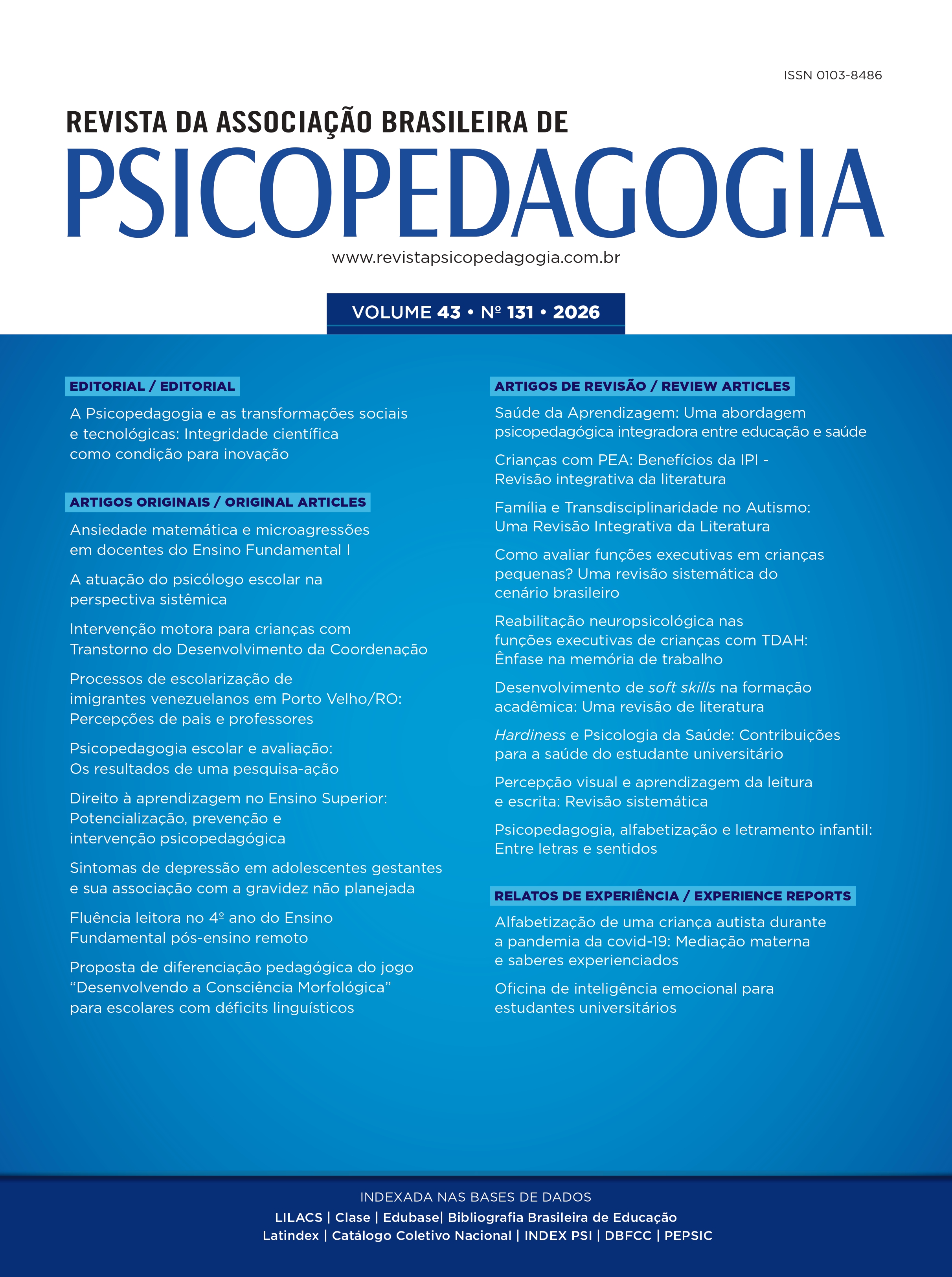
An integrative psychopedagogical approach bridging education and health
DOI:
https://doi.org/10.51207/2179-4057.20260041Keywords:
Psychopedagogy, Health of learning, Learning, HealthAbstract
The relationship between learning and health has increasingly been expanded through contributions from Learning Sciences, Developmental Psychology, Neurosciences, Education, and Health Sciences, highlighting that learning processes involve multiple dimensions of human development. Although contemporary literature recognizes the influence of health conditions on learning and their contribution to well-being, approaches that understand learning as a constitutive dimension of human health itself remain limited. This article, developed by the Psychopedagogy Study Group at PUC-SP, proposes the concept of Saúde da Aprendizagem (Health of Learning) as a psychopedagogical construct aimed at broadening the understanding of learning as a constitutive dimension of integral health. This qualitative theoretical study was developed through a narrative literature review based on national and international scientific production. From an interdisciplinary perspective, it is argued that Health of Learning represents a dynamic condition in which biological, cognitive, emotional, relational, and sociocultural factors are articulated, enabling individuals to establish meaningful relationships with knowledge, construct meanings, develop autonomy, and expand their possibilities for participation in the world. It is concluded that learning should not be understood only as a consequence of favorable health conditions, but also as a constitutive experience of human health itself. This perspective strengthens the epistemological field of Psychopedagogy and expands possibilities for understanding, assessment, and intervention in learning processes.
Downloads
References
Cantor, P., Osher, D., Berg, J., Steyer, L., & Rose, T. (2021). Malleability, plasticity, and individuality: How children learn and develop in context. Applied Developmental Science, 25(1), 1-31.
Canguilhem, G. (2009). O normal e o patológico (6ª ed.). Forense Universitária.
Darling-Hammond, L., Flook, L., Cook-Harvey, C., Barron, B., & Osher, D. (2020). Implications for educational practice of the science of learning and development. Applied Developmental Science, 24(2), 97-140.
Fernández, A. (1991). A inteligência aprisionada: abordagem psicopedagógica clínica da criança e sua família. Artes Médicas.
Gasparian, M. C. C. (2018). Psicopedagogia e processos de aprendizagem: desafios contemporâneos. Revista Psicopedagogia, 35(108), 1-12.
Noffs, N. A. (2010). Psicopedagogia: interfaces entre educação e saúde. Revista Psicopedagogia, 27(82), 77-86.
Noffs, N. A., & Mauricio, J. A. C. (2011). Brinquedoteca Hospitalar - um espaço educativo para a criança hospitalizada. In G. T. R. Silva & V. H. C. Espósito (Orgs.), Educação e saúde cenários de pesquisa em intervenção. Martinari.
Organisation for Economic Cooperation and Development. (2021). Beyond academic learning: First results from the survey of social and emotional skills. OECD Publishing.
Paín, S. (1985). Diagnóstico e tratamento dos problemas de aprendizagem. Artes Médicas.
Ryff, C. D. (2022). Positive psychology and well-being: Reconsidering mental health. Frontiers in Psychology, 13, 840932.
UNESCO. (2021). Reimagining our futures together: A new social contract for education. UNESCO.
Visca, J. (1987). Clínica psicopedagógica: epistemologia convergente. Artes Médicas.
World Health Organization. (2022). World mental health report: Transforming mental health for all. WHO.
Downloads
Published
How to Cite
Issue
Section
License
Copyright (c) 2026 Neide de Aquino Noffs, Maria Cecília Castro Gasparian

This work is licensed under a Creative Commons Attribution-NonCommercial 4.0 International License.


