
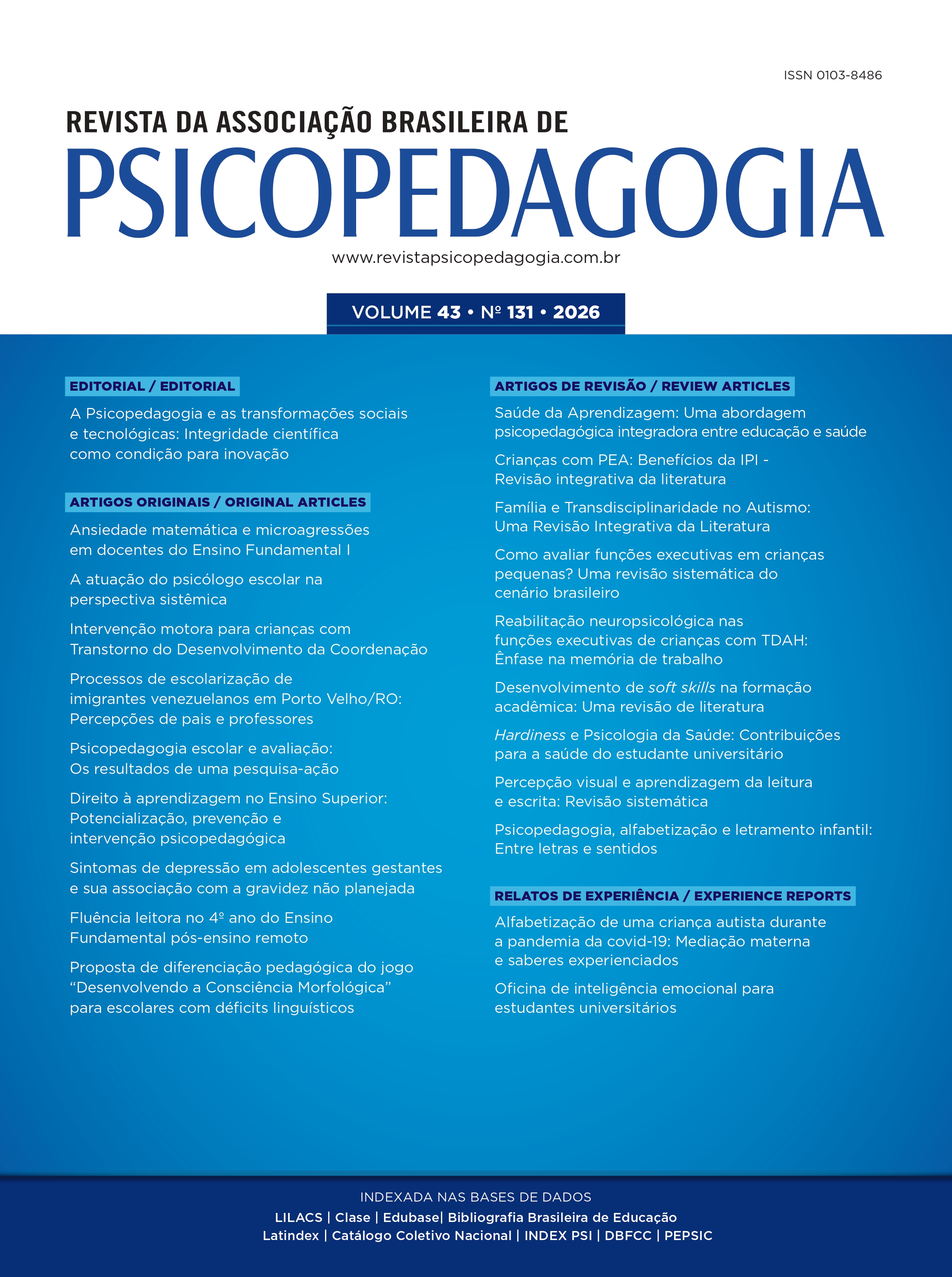
Neuropsychological rehabilitation in executive functions of children with ADHD
Emphasis on working memory
DOI:
https://doi.org/10.51207/2179-4057.20260036Keywords:
Neuropsychological Rehabilitation, Working Memory, Executive Function, ADHDAbstract
Attention Deficit Hyperactivity Disorder (ADHD) is a neurodevelopmental condition characterized by deficits in attention, impulsivity, and hyperactivity, often accompanied by impairments in executive functions, especially working memory. This research aims to investigate the contributions of neuropsychological rehabilitation in improving the working memory of children with ADHD, analyzing evidence on interventions and strategies that favor cognitive and behavioral performance. This is a narrative review of the literature, of a qualitative and descriptive nature, which integrates different theoretical and empirical approaches related to child neuropsychological rehabilitation. The results indicate that combined strategies—such as cognitive training, psychoeducation, compensatory strategies, and computerized programs—contribute to strengthening working memory and developing self-regulatory skills. It is observed, however, that the international scientific literature presents greater robustness of studies on the topic, while the national scenario still lacks systematic research that evaluates the effectiveness of these interventions. It is concluded that neuropsychological rehabilitation constitutes a promising resource in promoting functionality and autonomy in children with ADHD, and should be implemented in an interdisciplinary and contextualized manner.
Downloads
References
Abuhamad, M. (2019). Estimulação e reabilitação neuropsicológica da memória. In N. M. Dias, & C. O. Cardoso (Orgs.), Intervenção neuropsicológica infantil: Da estimulação precoce-preventiva à reabilitação (pp. 199-263). Pearson Clinical Brasil.
American Psychiatric Association. (2022). Manual diagnóstico e estatístico de transtornos mentais: DSM-5-TR (5ª ed.). Artmed.
Baddeley, A. D., & Hitch, G.J. (1974). Working memory. Recent Advances in Learning and Motivation. 8, 47-89.
Barkley, R. A. (2024). Tratando TDAH em crianças e adolescentes: O que todo clínico deve saber (1ª ed.). Artmed.
Blume, F., Hudak, J., Dresler, T., Ehlis, A. C., Kühnhausen, J., Renner, T. J., & Gavrilow, C. (2017). NIRS-based neurofeedback training in a virtual reality classroom for children with attention-deficit/hyperactivity disorder: Study protocol for a randomized controlled trial. Trials, 18(41), 1-16. https://doi.org/10.1186/s13063-016-1769-3
Cardoso, C. de O., & Fonseca, R. P. (2019). Intervenção neuropsicológica infantil. In N. M. Dias, & C. O. Cardoso (Orgs.), Intervenção neuropsicológica infantil: Da estimulação precoce-preventiva à reabilitação (pp. 69-95). Pearson Clinical Brasil.
Cardoso, T. da S. G., Feldberg, S. C. de F., & Mello, C. B. de. (2019). Intervenção neuropsicológica em lesões encefálicas na infância e na adolescência. In N. M. Dias, & C. O. Cardoso (Orgs.), Intervenção neuropsicológica infantil: Da estimulação precoce-preventiva à reabilitação (pp. 41-62). Pearson Clinical Brasil.
Cortese, S., Ferrin, M., Brandeis, D., Holtmann, M., Aggensteiner, P., Daley, D., Santosh, P., Simonoff, E., Stevenson, J., Stringaris, A., & Sonuga-Barke, E. J. S. (2016). Neurofeedback for attention-deficit/hyperactivity disorder: Meta-analysis of clinical and neuropsychological outcomes from randomized controlled trials. Journal of the American Academy of Child & Adolescent Psychiatry, 55(6), 444-455. https://doi.org/10.1016/j.jaac.2016.03.007
Dawson, P., & Guare, R. (2022). Inteligente mas disperso: O método revolucionário de habilidades executivas para ajudar no desenvolvimento de todos os potenciais da criança (1ª ed.). nVersos.
Dias, N. M. & Cardoso, C. O. (Orgs.) (2019). Intervenção neuropsicológica infantil: Da estimulação precoce-preventiva à reabilitação. Pearson Clinical Brasil.
Dias, N. M, & Mecca, T. P. (2019). Avaliação Neuropsicológica Cognitiva - Memória de Trabalho. Memnon.
Gerhardt, S. (2017). Por que o amor é importante: Como o afeto molda o cérebro do bebê (2ª ed.). Artmed.
Loschiavo-Alvares, F. Q. (2021). Manual de estratégias de reabilitação neuropsicológica para atenção, memória e funções executivas. Artesã.
Malloy-Diniz, L. F., & Dias, N. M. (2020). Funções executivas: Modelos e aplicações. Pearson Clinical Brasil.
Marques, A. P. P., Amaral, A. V. M., & Pantano, T. (2022). Treino de funções executivas e aprendizado (2ª ed.). Manole.
Miller G. A., Galanter E., & Pribram K. H. (1960). Plans and the structure of behavior. Holt, Rinehart & Winston.
Pribram, K. H. (1973). The primate frontal cortex: Executive of the brain. In K. H. Pribram & A. R. Luria (Eds.), Psychophysiology of the frontal lobes. Academic Press.
Pureza J. R., & Fonseca R. P. (2016). CENA Programa de Capacitação de Educadores Sobre Neuropsicologia da Aprendizagem com Ênfase em Funções Executivas e Atenção. Booktoy
Riesgo, R. S. (2016). Anatomia da Aprendizagem. In N. T. Rotta, L. Ohlweiler, & R. S. Riesgo (Eds.), Transtornos da Aprendizagem: Abordagem neurobiológica e multidisciplinar (2nd ed., pp. 9-26). Artmed.
Rossi, A. S. U., & Mello, C. B. de. (2019). Reabilitação neuropsicológica em pacientes com transtorno do déficit de atenção e hiperatividade. In L. F. Malloy-Diniz, & P. Mattos (Orgs.), Intervenções neuropsicológicas infantis: Aplicações e interfaces (pp. 63-98). Artmed.
Ruchkin, V., Wallonius, M., Odekvist, E., Kim, S., & Isaksson, J. (2024). Memory training with the method of loci for children and adolescents with ADHD-A feasibility study. Applied neuropsychology: Child, 13(2), 137–145. https://doi.org/10.1080/21622965.2022.2141120
Silva, J. P. da., & Nascimento, A. C. S. do. (2021). A relação entre a memória de trabalho e a aprendizagem escolar: Considerações e proposições. Brazilian Journal of Health Review, 4(3), 11680-11691. https://doi.org/10.34119/bjhrv4n3-158
Souza, I. de L. I., Faria, F. de F., & Anjos, E. G. C. dos., Meneghelli, C. M., Fujita, T. D., Caron, L., & Ivatiuk, A. L. (2021). Relações entre funções executivas e TDAH em crianças e adolescentes: Uma revisão sistemática. Psicopedagogia, 38(116), 197-213. https://pepsic.bvsalud.org/scielo.php?script=sci_arttext&pid=S0103-84862021000200006
Tourinho, A., Bonfim, C., & Alves, L. (2016). Games, TDAH e funções executivas: Uma revisão da literatura. In Anais do XV Simpósio Brasileiro de Jogos e Entretenimento Digital (SBGames). http://www.sbgames.org/sbgames2016/downloads/anais/157215.pdf
Zheng, Q., Kei, K. T., Chiu, K. Y., & Shum, K. K. (2024). Study protocol of a randomised controlled trial of the effects of near-infrared spectroscopy neurofeedback training coupled with virtual reality technology in children with ADHD. BMJ Open, 14(12), e093183. https://doi.org/10.1136/bmjopen-2024-093183
Zimmermann, N., & Araújo, N. B. de. (2019). Intervenções neuropsicológicas para a atenção em crianças e adolescentes. In N. M. Dias, & C. O. Cardoso (Orgs.), Intervenção neuropsicológica infantil: Da estimulação precoce-preventiva à reabilitação (pp. 181-198). Pearson Clinical Brasil.
Downloads
Published
How to Cite
Issue
Section
License
Copyright (c) 2026 Juciane de Holanda Santos

This work is licensed under a Creative Commons Attribution-NonCommercial 4.0 International License.


