
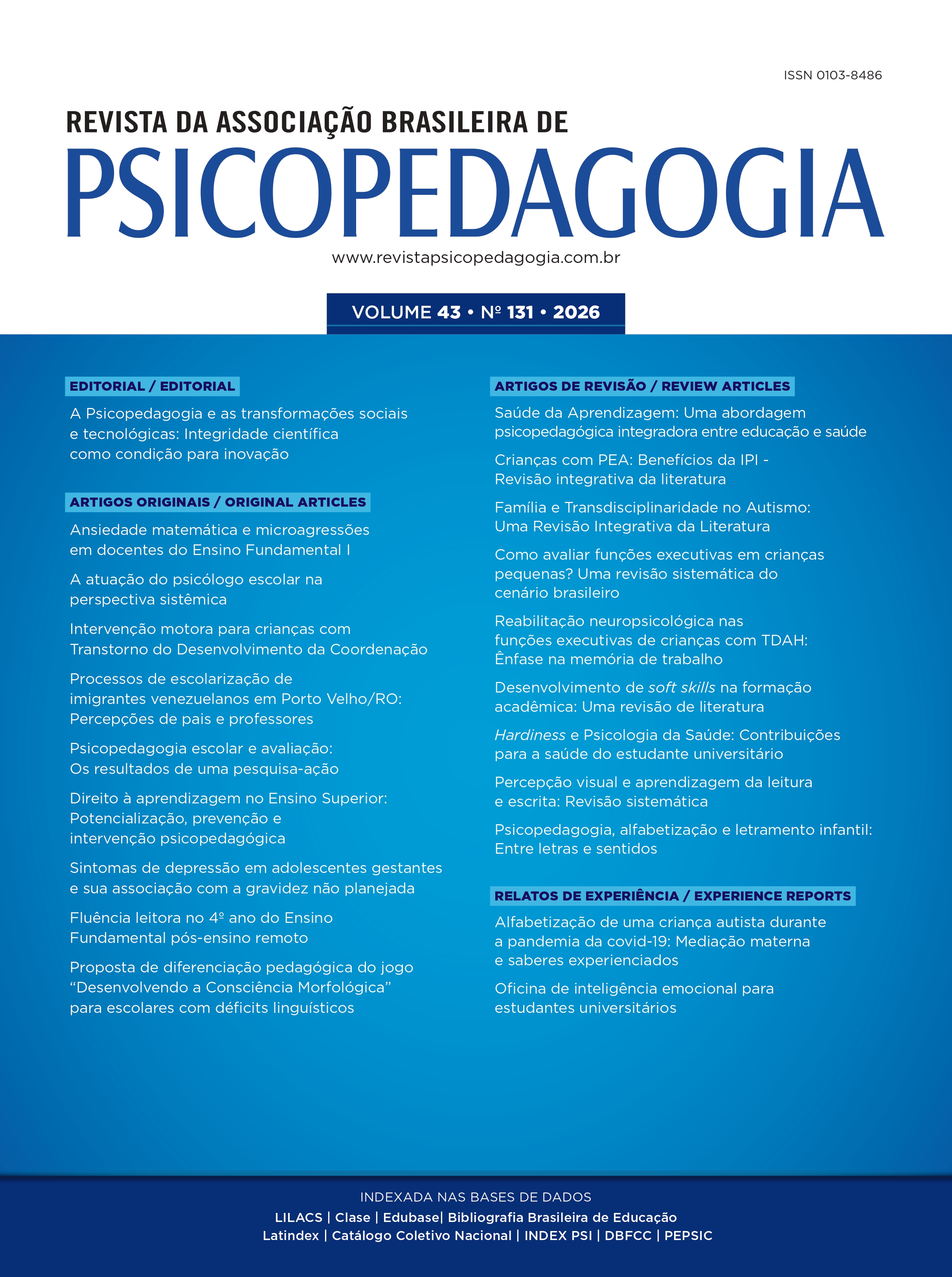
Educational psychopedagogy and assessment
The results of an action research study
DOI:
https://doi.org/10.51207/2179-4057.20260040Keywords:
Psychopedagogy, Teaching and learning processes, Historical-cultural psychology, Inclusive educationAbstract
This paper presents the results of an action research study conducted in 2018 with sixteen schools in the Toledo, Paraná, municipal school system. The objective was to investigate whether Psychopedagogical Assessments conducted by the Psychopedagogy Service, which is part of the teaching staff at all schools in the system, contribute to teaching practices that meet the educational needs of students with learning delays. We analyzed responses from 239 teachers (12% of the total) who completed in-person questionnaires. The results revealed that 58% of teachers reported being only formally informed of the assessment results, suggesting that this assessment contributes little to the pedagogical process in its current form. Additionally, we observed that the Psychopedagogical Assessment emphasizes the etiology of the deficit rather than the study of preferred pathways for accessing and mastering scientific knowledge. Based on the data, we reflected on the relevance of a psychopedagogical assessment grounded in Historical-Cultural Theory to contribute to education that promotes human development and the formation of a society of and for all.
Downloads
References
Associação dos Municípios do Oeste do Paraná. (2020). Proposta Pedagógica Curricular: educação infantil e ensino fundamental (anos iniciais): rede pública municipal: região da AMOP. Assoeste.
Bardin, L. (2015). Análise de Conteúdo. Edições 70.
Barroco, S. M. S., & Leonardo, N. S. T. (2016). A Periodização Histórico-Cultural do Desenvolvimento na Educação Especial. In L. M. Martins, A. A. Abrantes, & M. G. D. Facci (Orgs.), Periodização Histórico–Cultural do Desenvolvimento Psíquico: do nascimento à velhice (pp. 321-341). Autores Associados.
Kemmis, S., & McTaggart, R. (1988). Cómo planificar la investigación-acción. Laertes.
Moysés, M. A. A., & Collares, C. A. L. (2023). Novos modos de vigiar, novos modos de punir: a patologização da vida. Educação, Sociedade & Culturas, 57, 31-44. DOI: https://doi.org/10.34626/esc.vi57.11
Pereira, M. S. N. (2010). Estratégias de Intervenção Psicopedagógica. FGF/POSEAD.
Prause, V. F. (2020). Transtorno do Espectro Autista: Atuação do Professor de Apoio Pedagógico no Ensino Fundamental. [Dissertação de mestrado, Universidade Estadual do Oeste do Paraná]. https://tede.unioeste.br/handle/tede/5205
Teixeira, A. (2021). O Trabalho Colaborativo entre o professor de Educação Especial que atua na Sala de Recursos Multifuncionais e o do ensino comum em escolas públicas. [Dissertação de mestrado, Universidade Estadual do Oeste do Paraná]. https://tede.unioeste.br/handle/tede/5472
Teixeira, A., & Szymanski, M. L. S. (2021). O Trabalho Colaborativo entre o professor de Educação Especial que atua na Sala de Recursos Multifuncionais e o do ensino comum [Sessão de Artigos] 40ª. Reunião Nacional da ANPED. https://anais.anped.org.br/40reuniao/trabalhos/o-trabalho-colaborativo-entre-o-professor-de-educa%C3%A7%C3%A7%C3%A3o-especial-que-atua-na-sala
Toledo. (2024). Projeto Político-Pedagógico Secretaria Municipal da Educação de Toledo. Secretaria Municipal de Educação.
Vigotski, L. S. (2018). Sete aulas de L. S. Vigotski sobre os fundamentos da Pedologia. E-Papers.
Vigotski, L. S. (2022). Obras Completas – Tomo Cinco: Fundamentos de Defectologia. EDUNIOESTE.
Vigotski, L. S., Luria, A. R., & Leontiev, A. (2010). Linguagem, Desenvolvimento e Aprendizagem. Ícone.
Downloads
Published
How to Cite
Issue
Section
License
Copyright (c) 2026 Elenice de Souza, Maria Lídia Sica Szymanski, Elissiane Aparecida Zen do Amaral

This work is licensed under a Creative Commons Attribution-NonCommercial 4.0 International License.


