
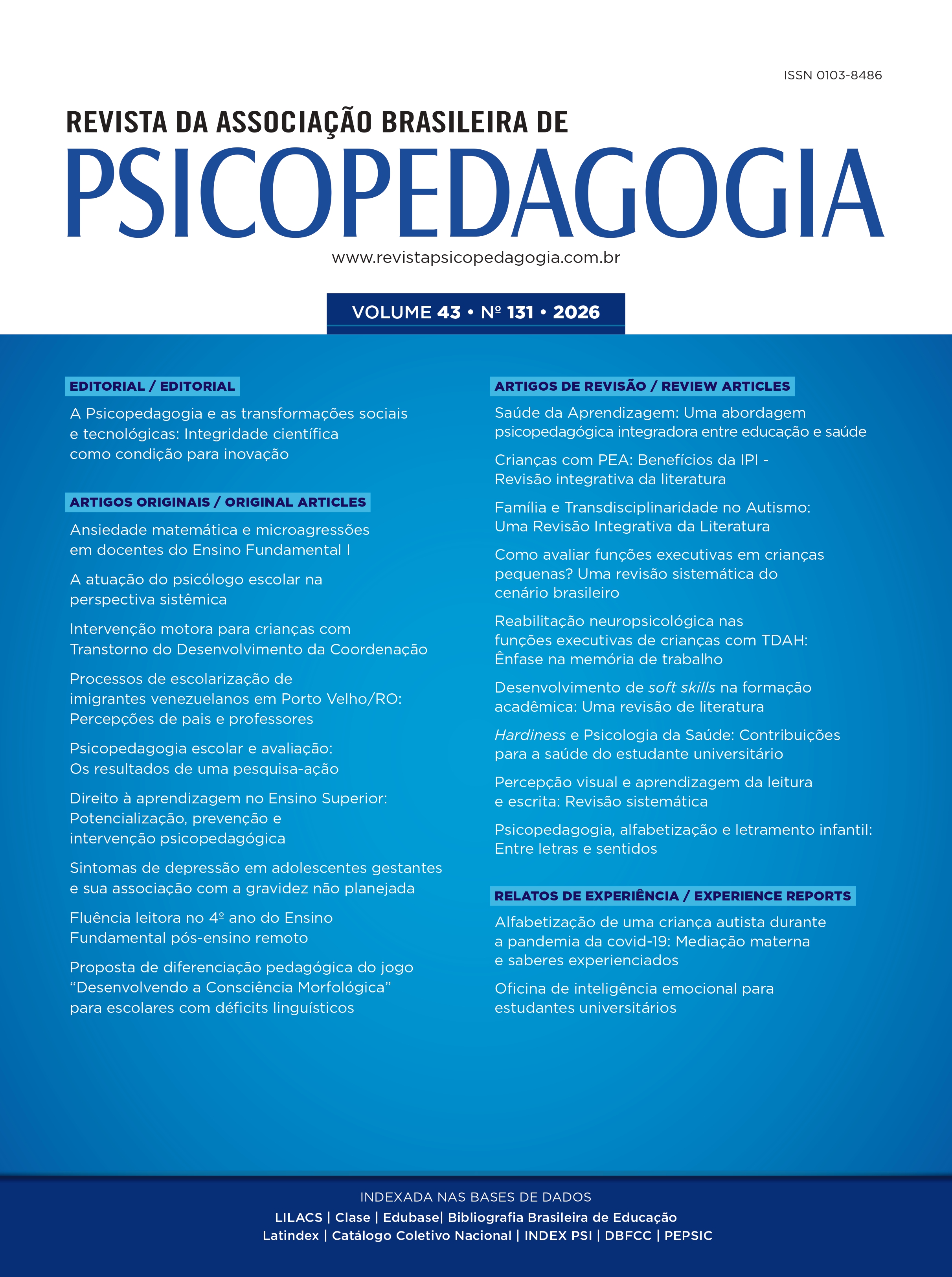
Intervenção motora para crianças com Transtorno do Desenvolvimento da Coordenação
DOI:
https://doi.org/10.51207/2179-4057.20260030Resumo
Crianças com Transtorno do Desenvolvimento da Coordenação (TDC) apresentam desempenho motor abaixo do esperado para a idade, além de dificuldades em áreas como a social e a acadêmica. O objetivo deste estudo foi investigar os efeitos de uma intervenção motora no desempenho motor e na autopercepção de competência de crianças com TDC. Participaram 28 crianças, com idade média de 7,4 anos (dp=1,3), caracterizadas com TDC ou em zona de risco. A caracterização do TDC foi realizada por meio do Movement Assessment Battery for Children (MABC-2), enquanto o Test of Gross Motor Development-3 (TGMD-3) avaliou o desempenho motor e o Pictorial Scale of Perceived Movement Skill Competence (PMSC) mediu a autopercepção de competência. A intervenção contou com 43 sessões e foi desenvolvida em ambiente escolar. Os resultados indicaram melhoras significativas no desempenho motor, mas não foram observadas mudanças significativas na autopercepção de competência motora.
Downloads
Referências
Adolph, K. E., & Hoch, J. E. (2019). Motor development: Embodied, embedded, enculturated, and enabling. Annual Review of Psychology, 70(1), 141-164. https://doi.org/10.1146/annurev-psych-010418-102836
American Psychiatric Association (2014). Manual diagnóstico e estatístico de transtornos mentais (C. Dornelles, Trad.). APA.
Barnett, A. L., & Prunty, M. (2021). Handwriting difficulties in developmental coordination disorder (DCD). Current Developmental Disorders Reports, 8, 6-14. https://doi.org/10.1007/s40474-020-00216-8
Barnett, L. M., Ridgers, N. D., Zask, A., & Salmon, J. (2015). Face validity and reliability of a pictorial instrument for assessing fundamental movement skill perceived competence in young children. Journal of Science and Medicine in Sport, 18(1), 98-102. https://doi.org/10.1016/j.jsams.2013.12.004
Blank, R., Barnett, A. L., Cairney, J., Green, D., Kirby, A., Polatajko, H., Rosenblum, S., Smits-Engelsman, B., Sugden, D., Wilson, P., & Vinçon, S. (2019). International clinical practice recommendations on the definition, diagnosis, assessment, intervention, and psychosocial aspects of developmental coordination disorder. Developmental Medicine & Child Neurology, 61(3), 242-285. https://doi.org/10.1111/dmcn.14132
Cairney, J., Hay, J. A., Veldhuizen, S., Missiuna, C., & Faught, B. E. (2010). Developmental coordination disorder, sex, and activity deficit over time: a longitudinal analysis of participation trajectories in children with and without coordination difficulties. Developmental Medicine & Child Neurology, 52(3), e67-e72. https://doi.org/10.1111/j.1469-8749.2009.03520.x
Camden, C., Wilson, B., Kirby, A., Sugden, D., & Missiuna, C. (2015). Best practice principles for management of children with developmental coordination disorder (DCD): results of a scoping review. Child: care, health and development, 41(1), 147-159. https://doi.org/10.1111/cch.12128
De Souza, M. S., Nobre, G. C., & Valentini, N. C. (2023). Effect of a motor skill-based intervention in the relationship of individual and contextual factors in children with and without Developmental Coordination Disorder from low-income families. Psychology of Sport and Exercise, 67, 102406. https://doi.org/10.1016/j.psychsport.2023.102406
Derikx, D. F., & Schoemaker, M. M. (2020). The nature of coordination and control problems in children with developmental coordination disorder during ball catching: A systematic review. Human Movement Science, 74, 102688. https://doi.org/10.1016/j.humov.2020.102688
Dewey, D., & Volkovinskaia, A. (2018). Health-related quality of life and peer relationships in adolescents with developmental coordination disorder and attention-deficit–hyperactivity disorder. Developmental Medicine & Child Neurology, 60(7), 711-717. https://doi.org/10.1111/dmcn.13753
Fastame, M. C. (2020). The contribution of motor functions to academic achievement in primary school: State of the art and future directions. School Psychology International, 41(6), 522-542. https://doi.org/10.1177/0143034320954494
Henderson, S. E., Sugden, D. A., & Barnett, A. (2007). Movement Assessment Battery for Children. Second Edition. Pearson Assessment.
Jane, J. Y., Burnett, A. F., & Sit, C. H. (2018). Motor skill interventions in children with developmental coordination disorder: a systematic review and meta-analysis. Archives of Physical Medicine and Rehabilitation, 99(10), 2076-2099. https://doi.org/10.1016/j.apmr.2017.12.009
Koo, T. K., & Li, M. Y. (2016). A guideline of selecting and reporting intraclass correlation coefficients for reliability research. Journal of Chiropractic Medicine, 15(2), 155-163. https://doi.org/10.1016/j.jcm.2016.02.012
Lino, F., Arcangeli, V., & Chieffo, D. P. R. (2021). The virtual challenge: Virtual reality tools for intervention in children with developmental coordination disorder. Children, 8(4), 270. https://doi.org/10.3390/children8040270
Miyahara, M., Lagisz, M., Nakagawa, S., & Henderson, S. (2020). Intervention for children with developmental coordination disorder: How robust is our recent evidence? Child: Care, Health and Development, 46(4), 397-406. https://doi.org/10.1111/cch.12763
Niemeijer, A. S., Smits-Engelsman, B. C., & Schoemaker, M. M. (2007). Neuromotor task training for children with developmental coordination disorder: a controlled trial. Developmental Medicine & Child Neurology, 49(6), 406-411. https://doi.org/10.1111/j.1469-8749.2007.00406.x
Organização Mundial da Saúde. (2018). Classificação Estatística Internacional de Doenças e Problemas Relacionados à Saúde: CID-11. Décima primeira revisão. Versão preliminar. OMS
Patel, D. R., Soares, N., & Wells, K. (2017). Neurodevelopmental readiness of children for participation in sports. Translational Pediatrics, 6(3), 167-173. https://doi.org/10.21037/tp.2017.05.03
Peyre, H., Albaret, J. M., Bernard, J. Y., Hoertel, N., Melchior, M., Forhan, A., Taine, M., Heude, B., De Agostini, M., Galéra, C., Ramus, F., & EDEN Mother-Child Cohort Study (2019). Developmental trajectories of motor skills during the preschool period. European Child & Adolescent Psychiatry, 28(11), 1461-1474. https://doi.org/10.1007/s00787-019-01311-x
Piek, J. P., Barrett, N. C., Allen, L. S. R., Jones, A., & Louise, M. (2005). The relationship between bullying and self-worth in children with movement coordination problems. British Journal of Educational Psychology, 75(3), 453-463. https://doi.org/10.1348/000709904X24573
Przysucha, E. P., & Maraj, B. K. (2014). Inter-limb coordination and control in boys with and without DCD in ball catching. Acta Psychologica, 151, 62-73. https://doi.org/10.1016/j.actpsy.2014.05.020
Ramalho, M. H. D. S., Valentini, N. C., Muraro, C. F., Gadens, R., & Nobre, G. C. (2013). Validação para língua portuguesa: lista de Checagem da Movement Assessment Battery for Children. Motriz: Revista de Educação Física, 19(2), 423-431. https://doi.org/10.1590/S1980-65742013000200019
Scott-Roberts, S., & Purcell, C. (2018). Understanding the functional mobility of adults with developmental coordination disorder (DCD) through the international classification of functioning (ICF). Current Developmental Disorders Reports, 5(1), 26-33. https://doi.org/10.1007/s40474-018-0128-3
Tamplain, P., Miller, H. L., Peavy, D., Cermak, S., Williams, J., & Licari, M. (2024). The impact for DCD–USA study: The current state of Developmental Coordination Disorder (DCD) in the United States of America. Research in Developmental Disabilities, 145, 104658. https://doi.org/10.1016/j.ridd.2023.104658
Thelen, E. (2004). The central role of action in typical and atypical development: A dynamic systems perspective. In I. Stockman (Ed.), Movement and action in learning and development: Clinical implications for pervasive developmental disorders (pp. 49-73). Academic Press.
Thelen, E., & Smith, L. B. (1994). A dynamic systems approach to the development of cognition and action. MIT Press.
Ulrich, D. A. (2019). TGMD-3: Test of gross motor development. Pro-Ed.
Valentini, N. C., Barnett, L. M., Bandeira, P. F. R., Nobre, G. C., Zanella, L. W., & Sartori, R. F. (2018). The pictorial scale of perceived movement skill competence: Determining content and construct validity for Brazilian children. Journal of Motor Learning and Development, 6(s2), S189-S204. https://doi.org/10.1123/jmld.2016-0043
Van Waelvelde, H., De Weerdt, W., De Cock, P., Smits-Engelsman, B. C., & Peersman, W. (2004). Ball catching performance in children with developmental coordination disorder. Adapted Physical Activity Quarterly, 21(4), 348-363. https://doi.org/10.1123/apaq.21.4.348
Wood, G., Miles, C. A., Coyles, G., Alizadehkhaiyat, O., Vine, S. J., Vickers, J. N., & Wilson, M. R. (2017). A randomized controlled trial of a group-based gaze training intervention for children with Developmental Coordination Disorder. PLoS One, 12(2), e0171782. https://doi.org/10.1371/journal.pone.0171782
Downloads
Publicado
Como Citar
Edição
Seção
Licença

Este trabalho está licenciado sob uma licença Creative Commons Attribution-NonCommercial 4.0 International License.


